
When we think about secure assessment, we often think of the exam moment itself. The candidate logs in, takes the exam under the right conditions and submits their work. There are agreements about time, permitted resources, supervision and assessment. When all of that runs smoothly, the exam feels reliable.
But a secure exam does not begin the moment someone clicks “start”. The foundation is laid much earlier: in the preparation, in the way access and roles are configured, in how exceptions are recorded and in the agreements about what happens when something does not go as expected. It is precisely this practical side that largely determines whether a digital exam takes place in a calm, fair and accountable way.
In digital assessment, security is therefore not only about the exam environment itself. It is also about the organisation around it. Who has access to which exam? Which tools are allowed? Where are exceptions recorded? Who can intervene if something goes wrong during the exam? And how do you ensure that decisions can be traced afterwards?
From a secure system to a reliable assessment process
A secure digital assessment environment is important, but in practice, reliability depends on more than technology. A system may be configured properly, while uncertainty can still arise about roles, exceptions or agreements during the exam. Conversely, a clear process can create a great deal of calm: everyone involved knows what needs to happen, candidates receive the right information and deviations are followed up in a consistent way.
That is also why access is such an important part of secure digital assessment. In this blog about SSO, Single Sign-On is described as a way for users to log in with one personal account through the institution’s central identity provider. This helps prevent separate passwords and shared accounts, while making management more straightforward.
Access is therefore not just a technical setting. It directly affects the practice of assessment: candidates must be able to take the right exam, assessors must be able to access the right work, invigilators need oversight and administrators must be able to rely on clear roles and permissions.
Exam reliability is built on four foundations
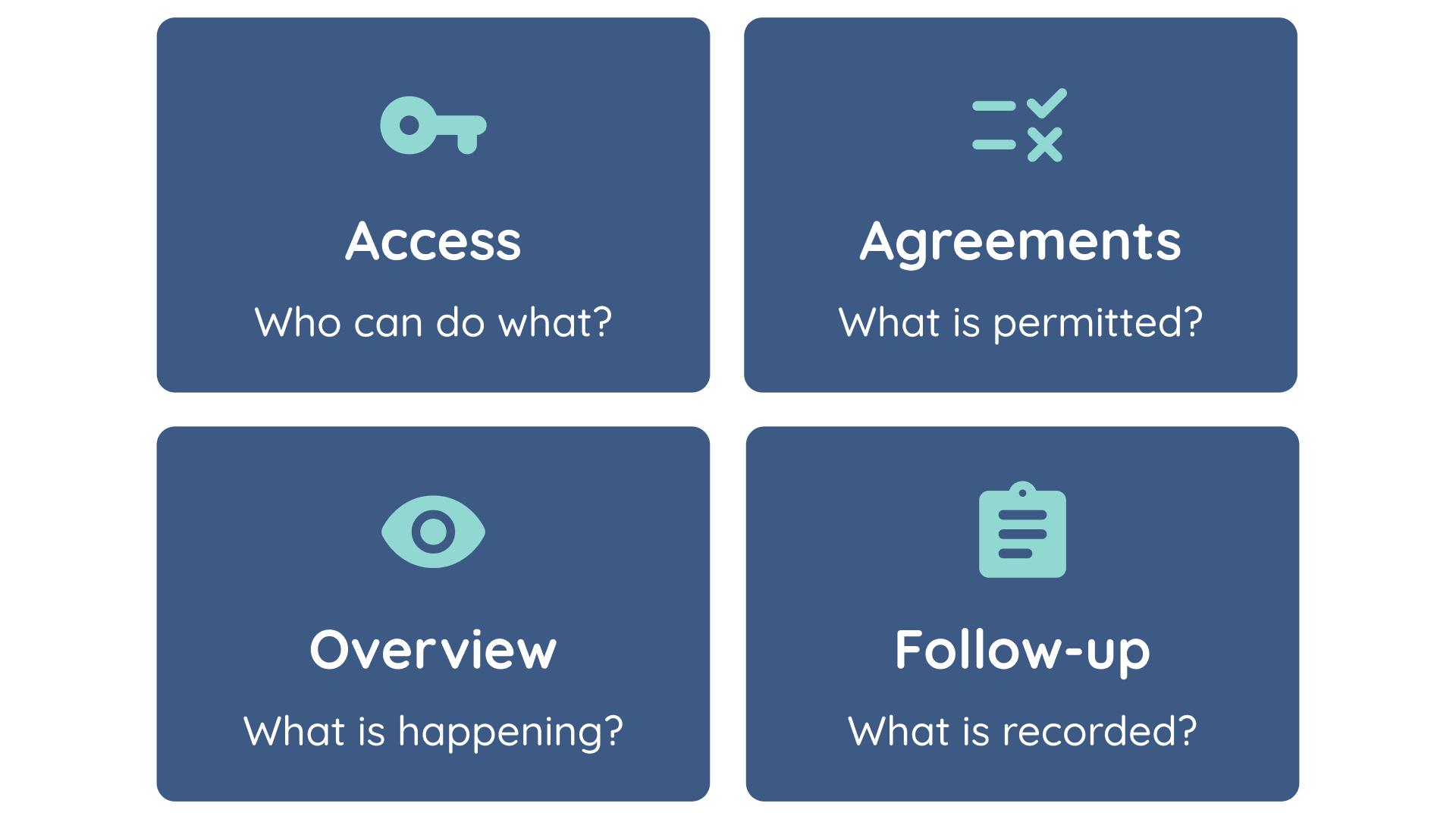
Clear agreements often make the difference
An exam may be well organised on paper, while in practice much still depends on small agreements. A candidate receives extra time. A group takes the exam at a different moment. An assessor needs temporary access. A lecturer wants to check something. Or an invigilator needs to know what to do when a candidate reports a technical issue.
These are not exceptional situations. They are part of the everyday reality of assessment and examination. That is precisely why it is important that such agreements do not remain hidden in separate emails, reminders or verbal handovers. The more that still needs to be figured out during the exam, the greater the pressure on the people managing the process.
Security does not mean that everything has to be locked down completely. Above all, it means that it is clear what is expected, who is responsible for what and where information can be found. That creates calm during the exam and makes it easier to explain afterwards how decisions were made.
AI and digital tools require clear choices
The discussion about permitted resources has become broader with digital assessment. It is no longer only about books, calculators or notes, but also about AI applications. Digital tools such as a digital calculator that is the same for everyone, text-to-speech software or the option to search within large texts, such as PDF attachments, are also playing an increasingly important role in assessment. This means organisations need to make conscious decisions about what fits the purpose of the exam.
For some assessment formats, the aim is mainly to determine what someone knows or can do independently. For other assignments, it may be perfectly logical for candidates to use sources, as long as it is clear what is being assessed. The key question is therefore not only: “How do we prevent every possible risk?” A better question is: “What do we want to measure with this exam, which tools support that purpose and how do we explain this clearly to candidates and assessors?”
That clarity helps everyone. Candidates need to know exactly what is and is not allowed. It is important that students can only use AI and other tools within clearly defined frameworks that have been established in advance. At the same time, lecturers and examiners need to assess from the same principles. This enables the organisation to explain afterwards why an exam was designed in a particular way.
Security without additional workload
When security is mainly translated into extra checks, the process can actually become heavier. Another list, another check, another manual comparison. Sometimes checks are necessary, but when they sit outside the process, they can also create additional opportunities for errors.
A more secure assessment process does not always have to be more complicated. Often, it helps to simplify the basics: clear roles, clear agreements, one place for important information and a consistent way to record exceptions. In that case, security feels less like something added on top of the work. It becomes part of how the exam delivery is organised.
This also aligns with the broader theme from the Remindo blog about digital marking: digital processes can contribute to more calm during the exam period, less manual work and greater trust in the assessment process. Add source: Remindo blog about digital marking
Questions that help sharpen your exam delivery process
Instead of approaching security only as a technical control, you can also start with a few practical questions. These help clarify, before the exam takes place, where uncertainty or friction may still arise.
- Do candidates know when, where and under which conditions they will take the exam?
- Is it clear which tools are and are not allowed?
- Are the roles and access rights of everyone involved correct?
- Has it been recorded which exceptions may occur and how they should be handled?
- Does everyone know what happens in the event of technical questions or deviations during the exam?
- Can important decisions be traced afterwards?
- Is it clear who may view, assess or process results?
If the answer to some of these questions is not yet clear, that does not immediately mean that the exam delivery is insecure. It mainly shows where the process can be made clearer, calmer or easier to transfer to others.
A secure exam is a well-prepared assessment process
Secure assessment ultimately comes down to trust. Trust that the right candidate takes the right exam. That agreements are clear. That exceptions are handled carefully. That results are produced reliably. And that the organisation can explain afterwards how the exam was conducted.
That is why a secure exam does not begin with supervision or the final check just before the exam. It begins with everything that has already been properly arranged beforehand: access, roles, agreements, communication, support and follow-up. A secure exam is therefore not only a well-protected exam environment, but above all a well-prepared assessment process.
Curious about what this looks like in practice?
Read Remindo’s customer stories or request a demo to discover how to organise digital exam delivery in a secure, structured and reliable way.
Read more about digital security:
https://www.remindo.com/blog/sso
https://www.remindo.com/blog/archiving