A good assessment requires a great deal of preparation from an organisation. The questions have been developed, the assessment has been assembled, checked and prepared. The schedule is correct. The right candidates have access. Exceptions have been processed. Assessors know what they need to do. And afterwards, results, feedback and analyses need to end up in the right place again.
This work often remains invisible. Until something goes wrong.
Because behind every good assessment lies a careful process of preparation, alignment and control. And that process largely determines how reliable, secure and manageable assessment is in practice.
Assessment quality is safeguarded in the process
When we talk about assessment quality, we often think first of the content. Are the questions clear? Do they align with the learning objectives? Is the assessment fair? And is it reliable? These are important questions. But assessment quality is not only found in the questions themselves. It is precisely the process around them that determines whether an assessment can function effectively.
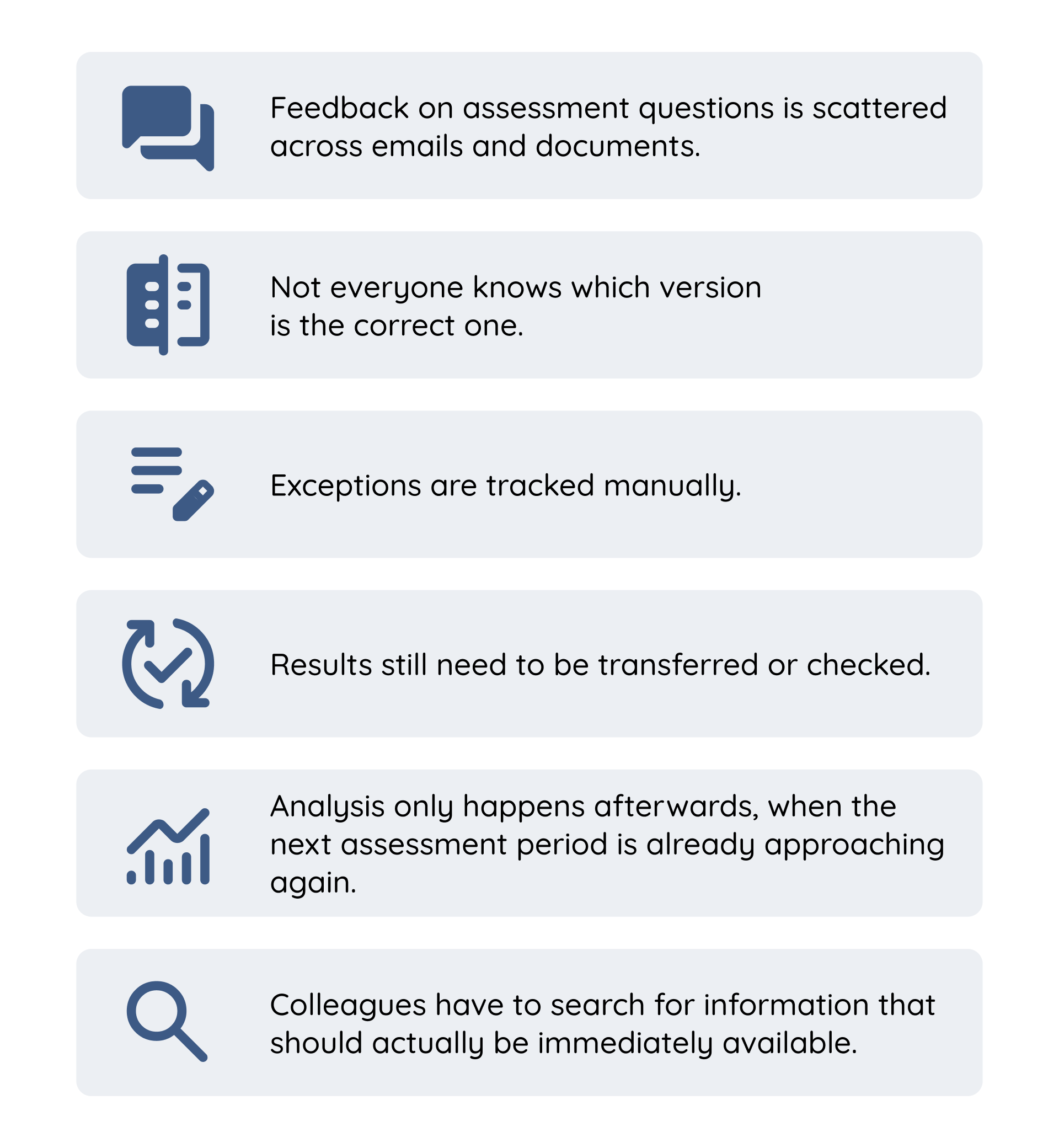
An assessment that is strong in terms of content can still become vulnerable if the surrounding process is not properly organised. Think of feedback scattered across emails or separate documents. Uncertainty about which version is the correct one. For example, if many assessments have the same name, you really need to check the logs to see when a specific assessment was last changed. Or perhaps certain information is mainly known by one colleague.
On paper, everything may seem to be in order. But in practice, a lot depends on people who know exactly where to look, who to ask and what still needs to be checked.
The problem is usually not a lack of commitment from people, but the way the process is organised.
Why fragmented assessment processes start to create friction
In many education and examination organisations, the assessment process grows step by step. A new programme is added, another assessment format is introduced, student numbers increase or stricter requirements arise around security and accountability. Often, organisations respond in a logical way: with a shared folder, a checklist, an extra control moment or a colleague who temporarily keeps track of something.
That works well for a while. Until the process becomes larger.
Then part of the information is stored in the assessment environment, part in a planning overview, part in meeting notes and part in mailboxes. And some agreements exist mainly in the minds of colleagues who have been working with the process for years.
You often notice this through small signals:
From separate files to a safeguarded process
For examination provider SVPB, a well-functioning process is also crucial. As an organisation that develops, administers and assesses exams, and issues diplomas, reliability is essential. At the same time, it became clear that working with separate files and Excel models was no longer sustainable in the long term.
By bringing the examination process together in one central and safeguarded digital system, SVPB gained more overview. Candidates can complete their cases digitally, and assessors can mark them directly online. This reduces manual work, lowers the risk of errors and makes the process easier to transfer.
In addition, a central environment helps exams better reflect real-life practice. Think of unique questions for each candidate and exam attempt, the use of videos in exams and real-time insight into progress during the exam. This makes examination more future-proof.
Not working harder, but organising smarter
In education and examination organisations, an enormous amount of work is absorbed by committed professionals. Assessment coordinators, teachers, examiners, functional administrators, quality officers and IT colleagues work together to ensure assessments take place, errors are corrected and candidates receive clarity.
But when a process relies too heavily on manual work, it demands more and more from those people.
A colleague quickly checks whether everyone has received the correct assessment. A teacher wonders whether the latest version of a question has already been processed. A candidate has an exception, such as extra time for candidates with dyslexia, but not everyone knows where that agreement is recorded. Or a team member is absent, causing others to search for information that would normally automatically end up with that person.
This takes time and energy. It also creates unrest during a period in which the organisation is often already under pressure.
Precisely because professionals absorb so much, the vulnerability of the process can remain hidden for a long time.
Growth makes small vulnerabilities bigger
The more assessments are administered, the faster small loose elements turn into a complex whole. For one assessment, it may still be manageable to track exceptions manually, check lists and record agreements separately. But with dozens of assessments, this becomes error-prone and time-consuming.
A good example is the organisation of admission tests. Because aspiring students take the test before or during their first year of study, and because multiple assessment moments also need to be tracked, the process is complex. Universities of applied sciences want insight into assessment moments, registrations and results, while students need to be guided through the process easily.
Examproviders bring this process together in one user-friendly and modular system. As a result, universities of applied sciences gained more control, students could be guided more easily and the process from registration to feedback became more transparent and manageable.
The result is less manual work, better handling of exceptions and more control for all parties involved.
A central environment makes the process visible
A central digital assessment environment does not automatically solve everything. But it does make visible where the process currently depends on loose agreements, documents and manual checks.
When questions, assessment matrices, administrations, marking and analyses come together in one environment, there is more control over the entire assessment cycle. Not only at the moment of administration, but especially before and after it.
This helps to distribute roles more clearly, track changes more effectively, record checks more thoroughly and use results more quickly for improvement. In this way, assessment becomes less dependent on separate handovers and more embedded in a safeguarded process.
Assessment quality starts before the assessment moment
For candidates, an assessment is often a single moment in time. For the organisation, it is part of a much larger process.
That is why it is valuable not only to look at the assessment itself, but also at everything that happens around it. This is often where opportunities lie to reduce workload, prevent errors and structurally strengthen the quality of assessment.
Assessment quality is created throughout the entire chain around it: in development, checking, planning, administration, marking and analysis.
The better that process is organised, the more room there is for what ultimately matters: fair, reliable and meaningful assessment.
Because a good assessment does not start when the candidate clicks “start”. It starts with everything that has already been carefully organised before that moment.
Curious to see what this looks like in practice?
Explore Remindo’s customer stories or request a demo to discover how other organisations are creating more overview, calm and control in their assessment process.